Jonathan Heights–Captain Montgomery relationship
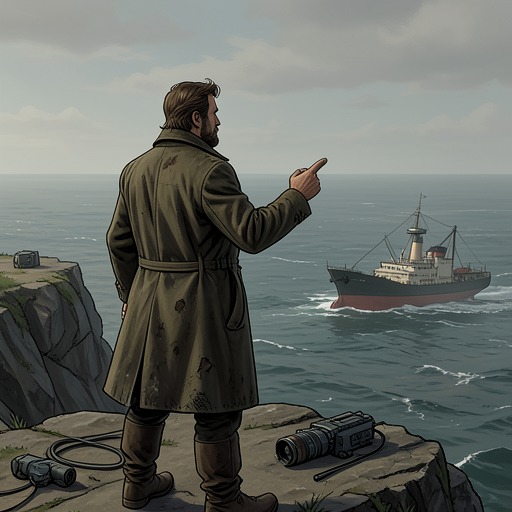
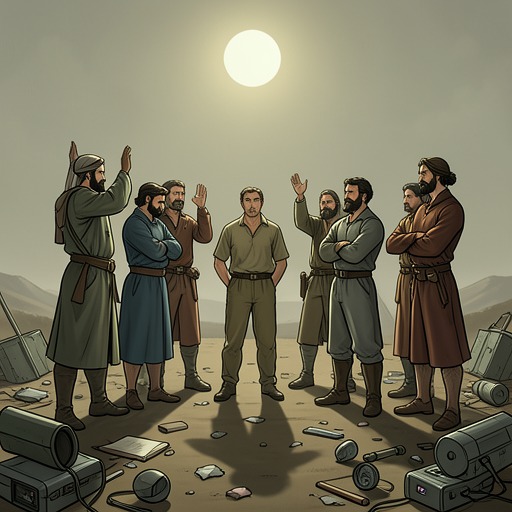
Chasing SunlightThe Jonathan Heights–Captain Montgomery relationship is the expedition’s governing partnership. Jonathan Heights knows the eastern darkness as a veteran explorer, while Captain Montgomery commands the Endeavor and must turn uncertain information into decisions that keep an airship and its people alive. Their alliance succeeds because neither man can perform the other’s function: Jonathan can read dangers, routes, peoples, and phenomena that ordinary navigation cannot explain, but Montgomery alone can direct the ship, allocate its fuel, and accept responsibility for the crew. The result is a relationship defined by competence, friction, and repeated acts of trust rather than by sentiment.
Formation of the Expeditionary Alliance
Jonathan’s far-eastern mission begins with an unusual claim: he says that he has seen sunlight and intends to find it again. The expedition is therefore both a geographical venture and a challenge to the settled assumptions of Beacon, where sunlight is treated as a laughable myth. Under the authority of the Illuminated King and amid the competing interests of the Reflected Council, agents of the crown and underworld join Jonathan aboard the Endeavor, making Montgomery the captain responsible for transporting a mission whose purpose remains politically and personally uncertain.
The relationship is strengthened by Jonathan’s preparation. He has charted crumbling mines, ruined cities, isolated oases, caravan migrations, and sources of raw terrestrite that can be refined into zint fuel. He understands that simply flying east will not suffice: the expedition must rest, resupply, repair damage, and recover its bearings in the black wilderness. Montgomery provides the institutional and mechanical means for that plan, while Jonathan supplies the accumulated field knowledge that makes it more than a blind venture. Their partnership consequently begins as a division of labor, but the hazards of the journey repeatedly force it into direct consultation.
Complementary Expertise and Risk Judgment
Montgomery’s command is practical and immediate. When a ship running dark moves to intercept the Endeavor, he reports that even the engines Jonathan obtained cannot compensate for the pursuing vessel’s superior power. He recognizes that the Endeavor is armored and armed but not a battleship, and he frames the danger in terms of what the ship can actually withstand. Jonathan, by contrast, tends to assess threats through experience of ruins and anomalous landscapes. When the expedition awakens an unknown creature or phenomenon in a ruined city, he does not pretend to identify it; his long experience makes him certain only that it is not something the party can fight. He leads the retreat while heat, wind, beasts, and vermin surge behind them, translating uncertain knowledge into the decisive order to withdraw.
Their different risk thresholds become most visible in navigation. After Ukaresh disappears, the city’s symbol is erased from Jonathan’s map as though it had never existed, leaving the Endeavor without a normal landmark. Montgomery states that the loss creates a serious hole in navigation and asks Jonathan to help recover their bearings. Jonathan responds not by forcing a direct eastern course but by recommending that they allow themselves to be pushed backward. He identifies a southern route that will lead into a sargasso, explains that the region will resemble an ocean whose far side recedes when approached, and proposes burning through it with fire dust before taking a known ridgeline. Montgomery supplies the navigational discipline and engine control; Jonathan supplies the map of hazards and the counterintuitive route.
The same division appears when the Endeavor encounters a distressed ship associated with the Cult of Flame. Montgomery insists that the crew are still men and that a good captain does not abandon airmen in distress, especially in the east. Jonathan supports cooperation partly because the Cult of Flame can handle fire dust more safely and skillfully, but Montgomery is the one who turns that principle into an operational commitment. When Antomine objects, Montgomery refuses to offer half the Endeavor’s supplies while still insisting that the two ships can work together to escape. His judgment is neither reckless generosity nor doctrinal obedience; it is a captain’s calculation of what assistance is feasible without endangering his own crew.
Cooperation Under Extraordinary Threats
The relationship becomes a repeated exchange between Jonathan’s specialized knowledge and Montgomery’s command decisions. At the Arch of Khokorron, Jonathan brings out a notebook of drawings and explains how the crew can reach the tether dock. Because the machinery is badly maintained, he equips the party with rods bearing flowers from Ukaresh, whose freezing will indicate an unsafe route. Montgomery does not merely remain behind to issue orders: curiosity overcomes caution, and he joins the detail himself, carrying a flower-rod and a pistol alongside the experienced expedition men. Jonathan leads the party across a spar as broad as a causeway, while Montgomery accepts the physical risk of entering a structure whose machinery is larger than Beacon’s central tower and whose workings cannot be approached by ordinary methods.
Montgomery’s participation changes the texture of their cooperation. He remains the captain, but he is also willing to enter the unknown directly when the expedition’s success requires it. Jonathan’s instructions make that participation possible, yet Montgomery’s presence signals that command is not being delegated away. The two men therefore meet at the threshold between expertise and action: Jonathan knows how the Arch may be approached, while Montgomery shares the danger of carrying out that approach.
The storm near the Grave of Wood exposes the limits of both men’s control. Montgomery asks Jonathan how worried they should be when an eastern storm develops behind the Endeavor, and Jonathan admits that he has never seen such a phenomenon. He can compare it with western storms, recognize that the protections obtained from Angkor Leng may help, and warn that wind remains dangerous regardless of origin, but he cannot provide a remedy. When the storm becomes a rolling cylinder of stone, light, lightning, and debris, Montgomery asks whether Jonathan can do anything. Jonathan reveals that his only remaining resource is an amphora of unflame, which is useless against something with nothing apparent to burn, and acknowledges that the ship’s survival now depends on Montgomery’s flying. The exchange is important because Jonathan’s authority does not require omniscience: he knows when knowledge ends, and Montgomery knows when command must continue without it.
A similar balance appears when Montgomery asks about the Players and the Game after the strange interlude aboard the Endeavor. Antomine offers reassurance that the beings are unlikely to cause further trouble, while acknowledging that there would be little anyone could do if they did. Jonathan does not challenge the captain’s concern with a false promise of safety; he allows Antomine to explain the matter and returns to the maps, aware that the Dead Battle’s shifting nature has made navigation uncertain. Montgomery’s question gives practical form to a metaphysical danger, while Jonathan’s silence recognizes that some threats cannot be managed by ordinary seamanship.
Authority, Friction, and Mutual Respect
Jonathan’s relationship with Montgomery is not free of strain. Jonathan’s pursuit of sunlight repeatedly encourages him to accept dangers that Montgomery must judge from the standpoint of the Endeavor’s survival. Montgomery’s responses are often terse, and he can be visibly sour when Jonathan’s decisions create navigational or material problems. Yet he does not reduce Jonathan to a reckless passenger. When the loss of Ukaresh removes the ship’s landmark, he consults Jonathan rather than treating the explorer’s knowledge as the source of the problem. When Jonathan proposes the dangerous sargasso route, Montgomery examines the map, questions whether the river can be followed east, and then incorporates the explanation into his planning.
Jonathan, for his part, recognizes Montgomery’s authority even when he resists other forms of command. He goes to the bridge to address the course after the eastern upheaval and accepts the captain’s need to regain bearings. He also understands that Montgomery’s concern for the distressed Cult of Flame ship is not sentimental weakness but professional obligation. Although Jonathan sometimes endorses a proposal in order to undermine Antomine, he still treats Montgomery’s judgment as the decisive practical counterweight to religious or ideological authority.
Their disagreements therefore remain functional rather than personal. Montgomery asks for usable answers: how dangerous is the storm, where can the ship go, what assistance can be offered, and whether the crew is safe? Jonathan answers with maps, remembered routes, field experience, linguistic knowledge, and warnings about phenomena that resist classification. Neither man possesses complete control, but each respects the other’s competence enough to keep consulting him. Their conversations turn fear into procedure without ever making the east ordinary.
The Expedition’s Return and Continuing Partnership
By the time the Endeavor reaches the edge of the map and the approach to Bright Defile, the expedition has consumed much of its equipment and knowledge. Jonathan’s esoterica, provisions, and working materials have been used; his books and notes are scattered through emptied crates, and he finds no tool, trick, reference, or surviving record that can aid the final approach. He tells Montgomery that the remaining trek must be made on foot and that the entrance to Bright Defile, and sunlight itself, are what make the terrain extraordinary. Montgomery answers that he will believe it when he sees it, while his greater immediate concern remains the damage to the Endeavor. The exchange captures their enduring contrast: Jonathan is fixed on revelation, Montgomery on the vessel that has carried them there.
Their partnership survives the expedition’s catastrophic consequences. After the Endeavor returns to Beacon, the combined disturbances are remembered as the Winter of Blood, while the airmen profit from artifacts connected with the destruction of Tor Ilek; many become wealthy enough to retire, and some acquire a new airship. Captain Montgomery nevertheless prepares the Endeavor for another expedition. The reasons for his return to the east are unclear, since he already has enough money for a lifetime, but the continuation of the voyage shows that the relationship between Jonathan’s knowledge and Montgomery’s command belongs to an ongoing expeditionary pattern rather than a single assignment. When Eleanor later remarks that the departure is less auspicious, Montgomery replies that, considering what happened last time, he is satisfied with that. His dry caution does not end the partnership; it becomes part of the discipline with which the next journey begins.
Narrative and Thematic Significance
The Jonathan Heights–Captain Montgomery relationship embodies the book’s tension between exploration and responsibility. Jonathan treats the unknown as a summons and sunlight as an objective powerful enough to justify reaching beyond accepted maps. Montgomery treats every wonder as something that must be crossed by a damaged, fuel-consuming, crewed machine. Their alliance keeps neither impulse dominant. Jonathan prevents the Endeavor from becoming merely a ship lost in darkness, while Montgomery prevents Jonathan’s quest from becoming a purely individual descent into danger.
The relationship also gives the expedition a practical ethics. Maps, repaired engines, zint reserves, tether points, weapons, and crew discipline are not the opposite of mystery; they are the means by which human beings encounter mystery without surrendering everyone around them to it. Montgomery’s insistence that distressed airmen should not be abandoned and Jonathan’s willingness to admit when his own knowledge cannot help both reject the fantasy of total mastery. Their cooperation is strongest precisely when the east exposes the limits of expertise: one man identifies what cannot be fought or burned, and the other still has to fly the ship through it.
In this sense, Captain Montgomery is Jonathan’s indispensable counterforce and ally. He does not share every interpretation of the expedition, and he does not automatically believe Jonathan’s promise of sunlight. But he continues to ask Jonathan where danger lies, accepts his guidance through impossible terrain, and carries the Endeavor onward when maps, landmarks, and ordinary explanations fail. Jonathan’s quest may be driven by revelation, yet it reaches the edge of possibility through Montgomery’s steadier form of faith: the belief that a captain must make the next decision even when no safe decision exists.